Location: Bridges Auditorium front steps, Pomona College, Claremont, CA
Description of Space: Bridges Auditorium, known colloquially as “Big Bridges,” was built in 1931 to provide seating for 2,500 people. The auditorium was designed by architect William Templeton Johnson in a “free adaptation of Northern Italian Renaissance architecture.” The exterior is white and its front entrance consists of steps leading up to five large vaulting arches. Above each arch are five engraved faces and names of the composers: Wagner, Chopin, Beethoven, Bach, and Schubert. Underneath the archway is a patio leading to three massive wooden doors, framed by the middle three archways. If you shout or make a sound louder than a certain threshold, the building right across Big Bridges, Carnegie, will echo your sound.
Recording Setup: The recorder (Azden SGM-PDII Camera Shotgun Mic) and balloon were placed 4 inches above the ground and approximately 3ft apart in front of the center entrance door of Big Bridges.
Reverberation Time:
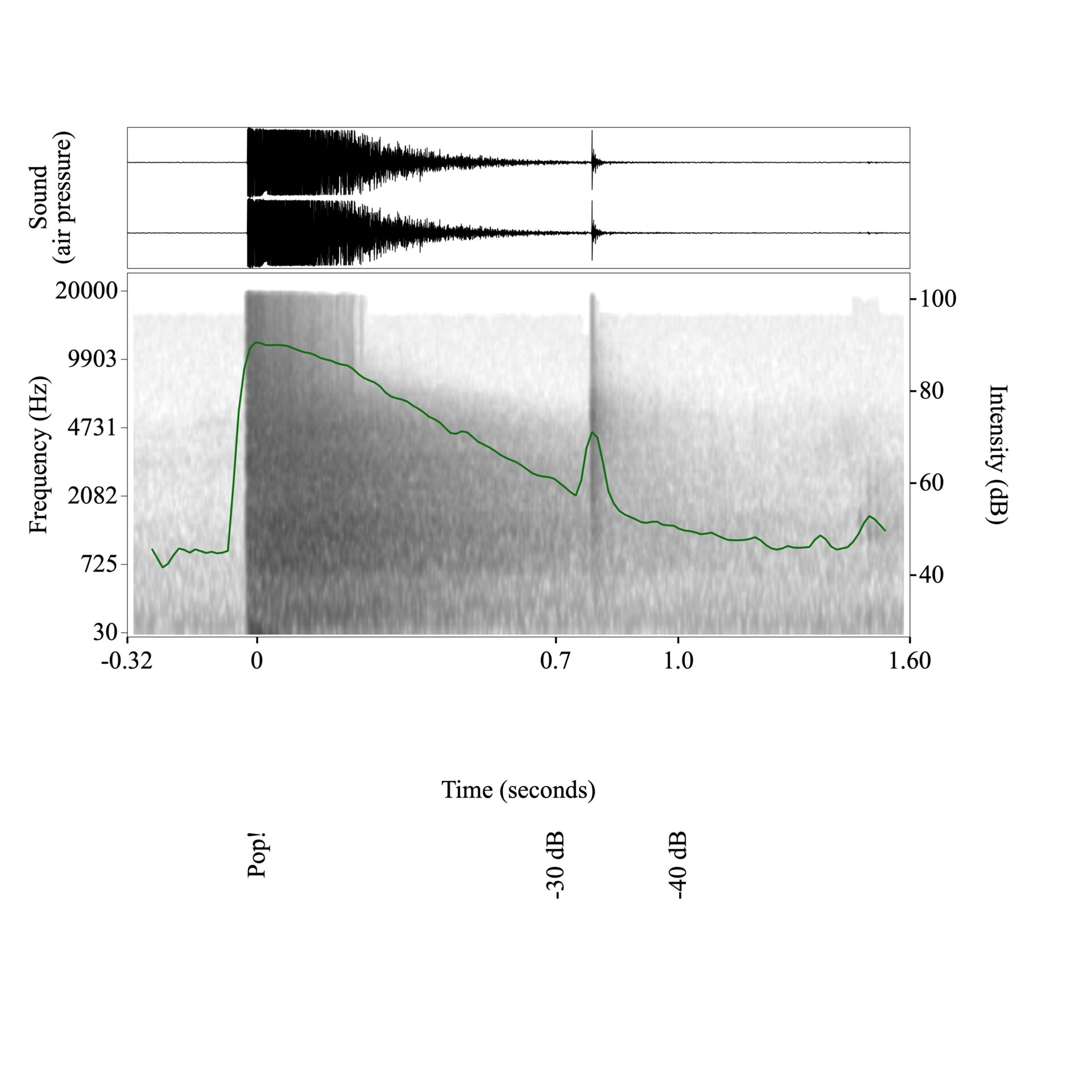
- Maximum Intensity: 90.68 dB
- Minimum Intensity: 41.55
- 30 dB decay: 0.73 seconds
- 40 dB decay: 1.03 seconds
- Decay to background level: 1.33 seconds
Acoustic Description:
The front steps of Big Bridges, whilst technically outdoors, provide a mostly enclosed environment for the sound waves to bounce off of. The columns, high vaulted arches, and ceiling roof amplify the reverberations of the balloon pop. The recorder and balloon were facing inward towards the wall, emphasizing the echo rather than into an open atmosphere. This leads to the relatively slow decay to background level, 1.33 seconds. There is also a spike of 70.94 dB at 0.82 ms after the pop, where you can hear that the popped balloon hit the ground. This may also explain the relatively slow decay to background level.
Graph: